Thursday, October 6, 2016

Adverbs and Advebials

An adverb is a word that is used to change or qualify the meaning of an adjective, a verb, a clause, another adverb, or any other type of word or phrase with the exception of determiners and adjectives that directly modify nouns.


  • Adverbs can always be used to modify verbs. Notice that the second of these two sentences is much more interesting simply because it contains an adverb
  • Adverbs are often formed by adding the letters “-ly” to adjectives. This makes is very easy to identify adverbs in sentences. There are many exceptions to this rule; everywhere, nowhere, and upstairs are a few examples
  • An adverb can be used to modify an adjective and intensify the meaning it conveys
Example of Adverbs:

  1. She was walking rapidly.
  2. The kids love playing together in the sandbox.
  3. Please come inside now.
  4. His jokes are always very funny.
  5. You don’t really care, do you?
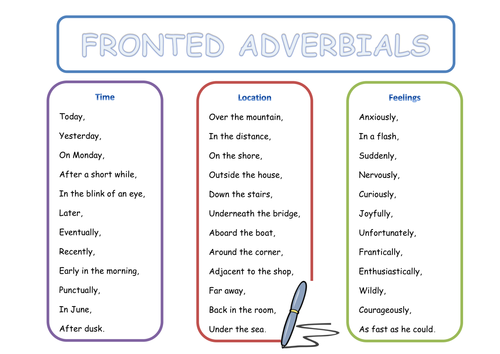
Adverbials 
a word or phrase functioning like an adverb that modifies or tells us something about the sentence or the verb. 


So that's it you Guys, I hope I helped you with your Grammar Stuffs
Hope to see you on my next one. Bye :)

Modifiers

Modifiers acts as the glitter of every sentences that adds beauty to every work.

The reporter defines Modifiers as words, phrases, or clauses that provide description in sentences. Modifiers allow writers to take the picture that they have in their heads and transfer it accurately to the heads of their readers. Essentially, modifiers breathe life into sentences. Modifiers can be adjectivesadjective clausesadverbsadverb clauses,absolute phrasesinfinitive phrasesparticiple phrases, and prepositional phrases. Without modifiers, sentences would be no fun to read. Carefully chosen, well-placed modifiers allow you to depict situations with as much accuracy as words will allow. 

Ex:
Poor Stephen, who just wanted a quick meal to get through his three-hour biology lab, quickly dropped his fork on the cafeteria tray, gagging with disgust as a tarantula wiggled out of his cheese omelet, a sight requiring a year of therapy before Stephen could eat eggs again.


Adjective = poor.
Adjective clause = who just wanted a quick meal.
Adverb = quickly.
Adverb clause = as a tarantula wiggled out of his cheese omelet.
Absolute phrase = a sight requiring a year of therapy before Stephen could eat eggs again.
Infinitive phrase = to get through his three-hour biology lab.
Participle phrase = gagging with disgust.
Prepositional phrase = on the cafeteria tray.

(c) Grammar Bytes for the example given 

So that's it you Guys, I hope I helped you with your Grammar Stuffs
Hope to see you on my next one. Bye :)

Modals

Modals were discussed by Ms. Braga, eventhough she has a "not so loud" she still manages to explain things up.

A modal is a type of auxiliary (helping) verb that is used to express: ability, possibility, permission or obligation. Modal phrases (or semi-modals) are used to express the same things as modals, but are a combination of auxiliary verbs and the preposition to. The modals and semi-modals in English are:
  1. Can/could/be able to
  2. May/might
  3. Shall/should
  4. Must/have to
  5. Will/would
We are using this kinds of helping verbs hence we don't know the real function of each verb and this report really helps us in understanding modals. 

So that's it you Guys, I hope I helped you with your Grammar Stuffs
Hope to see you on my next one. Bye :)

Auxiliary Verbs

Lorie Reported this topic she define auxiliary verb as a verb used in forming the tenses, moods, and voices of other verbs.

Auxiliary (or Helping) verbs are used together with a main verb to show the verb’s tense or to form a negative or question. The most common auxiliary verbs are have, be, and do.
  1. Does Sam write all his own reports?
  2. The secretaries haven’t written all the letters yet.
  3. Terry is writing an e-mail to a client at the moment.

Be

“Be” or “to be” is an important verb that has a multitude of uses in English. It can be used as an action verb that stands alone in all its tenses including be, to be, been, am, are, is, was, were, wasn’t, was not aren’t, are not, weren’t and were not.

Do

“Do” can be used as an action verb that stands alone in all its tenses, including to do, do, does,done, did and didn’t, doesn’t or did not 

Have

“Have” is a very important verb that can stand alone in all its tenses, including has, have, having, had, and hadn’t or had not. It is usually used to denote ownership, and it can also be used to discuss ability or describe appearance. “Have” is also a very popular substitute for the verbs “eat” and “drink.” For example: “Let’s have dinner.”
* This are the three common auxiliary verbs used in a sentence*

So that's it you Guys, I hope I helped you with your Grammar Stuffs
Hope to see you on my next one. Bye :)

Verbals

I guess it is really my time to shine. LOL

So I will be reporting things about verbals, it was nerve-wrecking tho but I need to finish this one and do my best to explain things to my class. 

A verbal is a verb form which functions as a noun or an adjective. there are three kinds of verbals: gerund, infinitives and participle.

Gerund are verbs that functions as a noun, they are easy to spot since every gerund ends with  -ing. they can be used as subject of the sentence, after a preposition, after phrasal verb, in compound noun and as a direct object.

[verb] + -ing = Gerund

Participles are verbs used as adjective. there are two types of participles: Present (ending in -ing)and Past (ends with -ed -d -t -en - or -n)

[verb] + -ing = Present

[verb] +-ed -d -t -en - or -n = Past

* You might be confused by Gerund and Present participle, they differ in usage. Gerund were used as a noun while Present Participle functions as an adjective.

Infinitives will almost began with to- followed by a simple form verb but there are special cases wherein to- is removed when it follows this thing called special verbs like feel, help, let, make, see and watch .

to- + [verb] = Infinitives

* There is this Split infinitives wherein to is separated to its partner(verb)

to+adjective+verb= split infinitives


So that's it you Guys, I hope I helped you with your Grammar Stuffs
Hope to see you on my next one. Bye :)

Subject Verb Agreement

This topic is really a hard one to memorize because there are so many Rules to understand and all of them really differs from one another. each rule represents a certain kind of sentence.

A singular subject takes a singular verb, whereas a plural subject takes a plural verb, is the most basic rule.
Rule 1. A subject will come before a phrase beginning with of. This is a key rule for understanding subjects. The word of is the culprit in many, perhaps most, subject-verb mistakes.Rule 2. Two singular subjects connected by or, either/or, or neither/nor require a singular verb.Rule 3. The verb in an or, either/or, or neither/nor sentence agrees with the noun or pronoun closest to it.Rule 4. As a general rule, use a plural verb with two or more subjects when they are connected by and.
Rule 5a. Sometimes the subject is separated from the verb by such words as along with, as well as, besides, not, etc. These words and phrases are not part of the subject. Ignore them and use a singular verb when the subject is singular.
Rule 5b. Parentheses are not part of the subject.
Rule 6. In sentences beginning with here or there, the true subject follows the verb.
Rule 7. Use a singular verb with distances, periods of time, sums of money, etc., when considered as a unit.
Rule 8. With words that indicate portions—e.g., a lot, a majority, some, all—Rule 1 given earlier in this section is reversed, and we are guided by the noun after of. If the noun after of is singular, use a singular verb. If it is plural, use a plural verb.
Rule 9. With collective nouns such as groupjuryfamilyaudiencepopulation, the verb might be singular or plural, depending on the writer's intent.

There are many more rules that can supply the explanation that you need in a certain sentence and can help you create a sentence that is grammatically correct. 
Yes it is indeed hard to memorize but this set of rules can really make a huge difference in your sentence writing.

So that's it you Guys, I hope I helped you with your Grammar Stuffs
Hope to see you on my next one. Bye :)


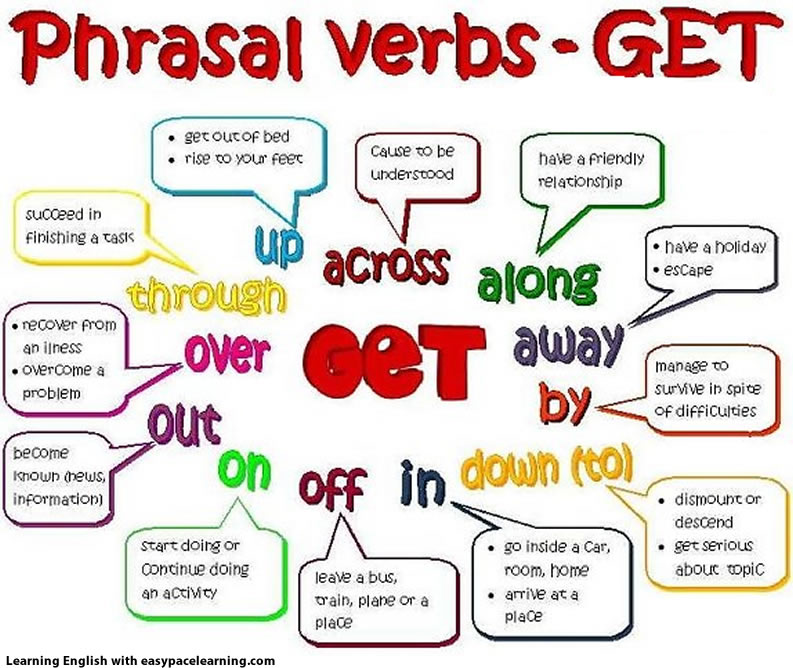
Phrasal Verbs

Patricia discussed Phrasal Verbs as a type of verb that is created when a main verb is combined with either: a verb, a preposition, or an adverb+ preposition. She gave us different hand-outs that we can use for us to be familiar with all the phrasal verbs that we can use when we are creating sentences.

1. Adverb

  • take off
  • give in
  • blow up
2. Preposition
  • get at (someone)
  • pick on (weaker children)
3. Adverb + Preposition 
  • get out of
  • put up with


Image result for phrasal verb

So that's it you Guys, I hope I helped you with your Grammar Stuffs
Hope to see you on my next one. Bye :)